Institute for Visual & Analytical Computing, Universität Rostock · * Equal Contribution
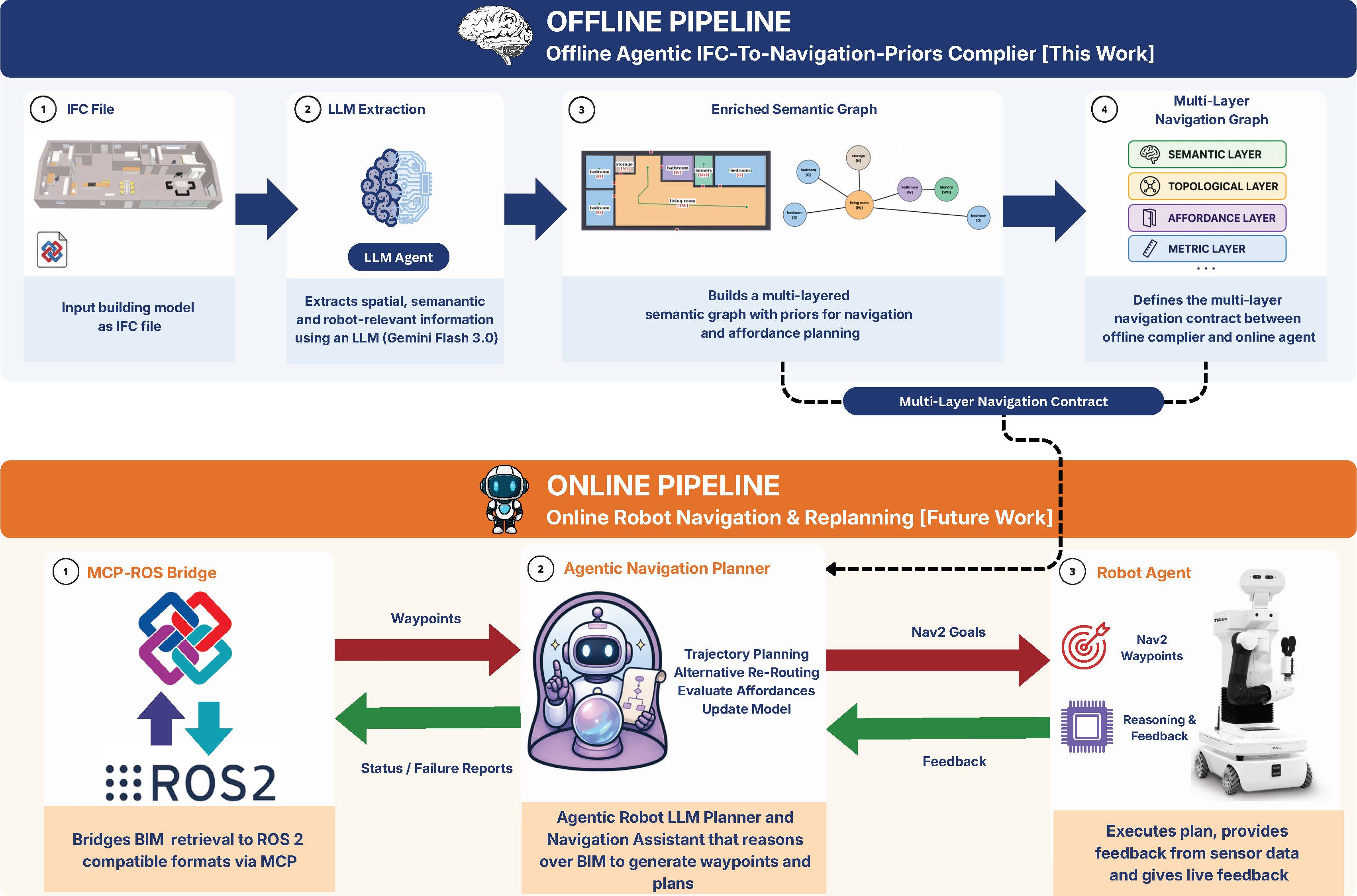
Building Information Models (BIM) stored in the Industry Foundation Classes (IFC) format contain rich priors for indoor robot autonomy. However, most pipelines use static one-pass conversions that produce occupancy maps or simulation assets while leaving much of the semantic information unused.
We present RoboBIM, an agentic pipeline that converts IFC files into metric-semantic navigation contracts. RoboBIM separates structural extraction from semantic enrichment. First, a deterministic backbone creates a reliable geometric baseline including occupancy maps, waypoints, and room topology. Then, an LLM agent infers missing semantic information — room types, hazards, and traversability — through sandboxed code execution. We also introduce an online query agent that retrieves these priors during robot operation.
RoboBIM converts IFC building models into semantically rich robot navigation contracts using a deterministic graph backbone + a 7-stage LLM enrichment layer, increasing room-type coverage by 74.5% and filling hazard, material, traversability, and policy fields left empty by the deterministic baseline.
RoboBIM has two main parts: a deterministic geometric backbone and an LLM agent wrapper. The backbone first extracts the structural graph Gstatic = (𝒪, 𝒲, 𝒯) and then the seven-stage agentic layer enriches this graph to produce Gagent = (𝒪, 𝒲, 𝒯, Σ).
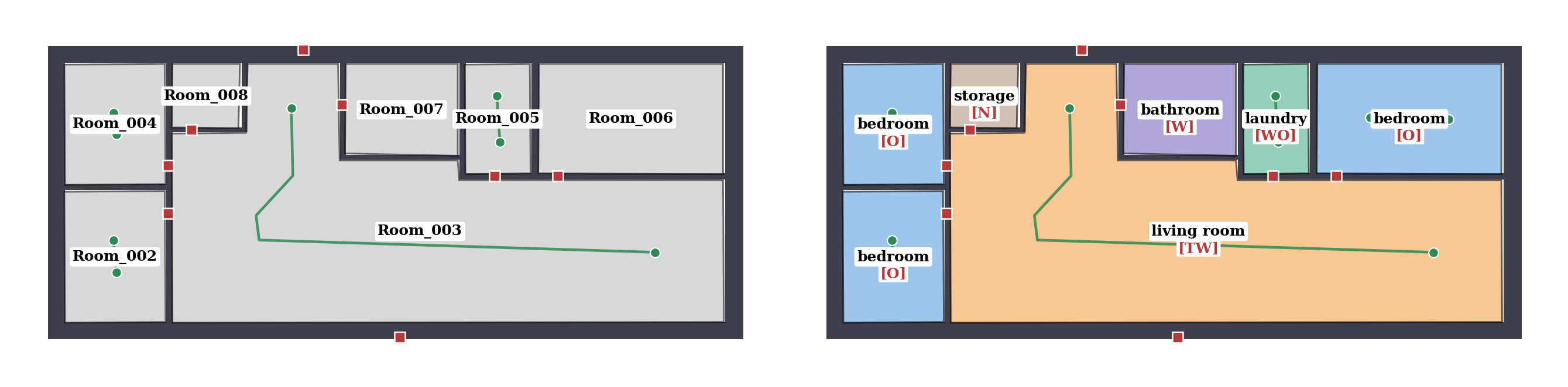
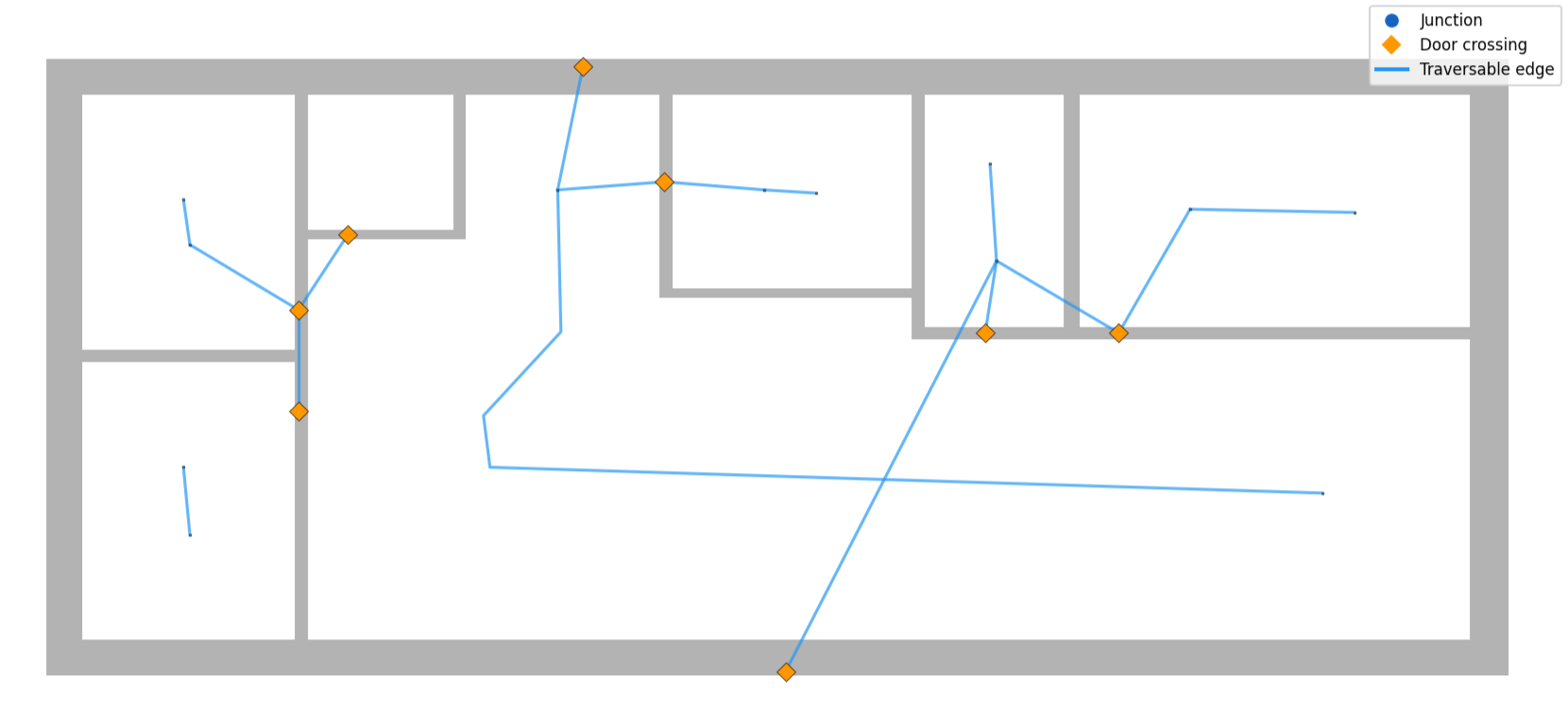
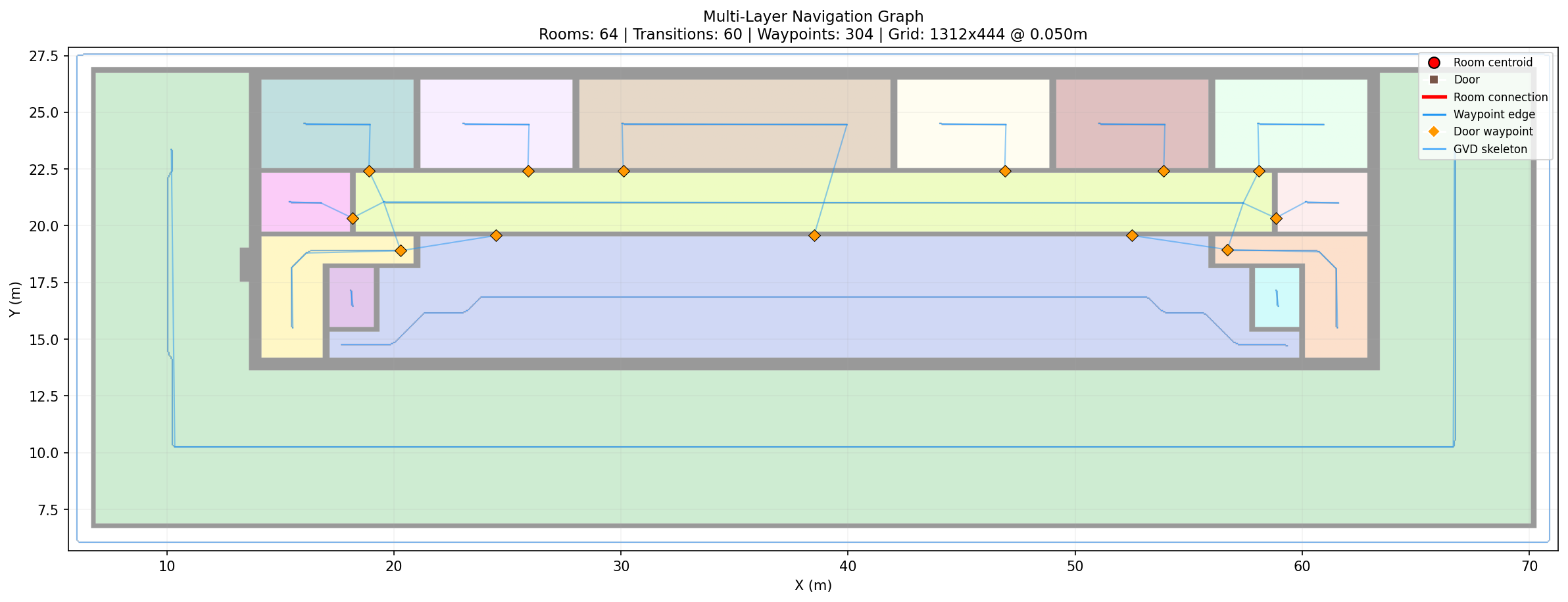
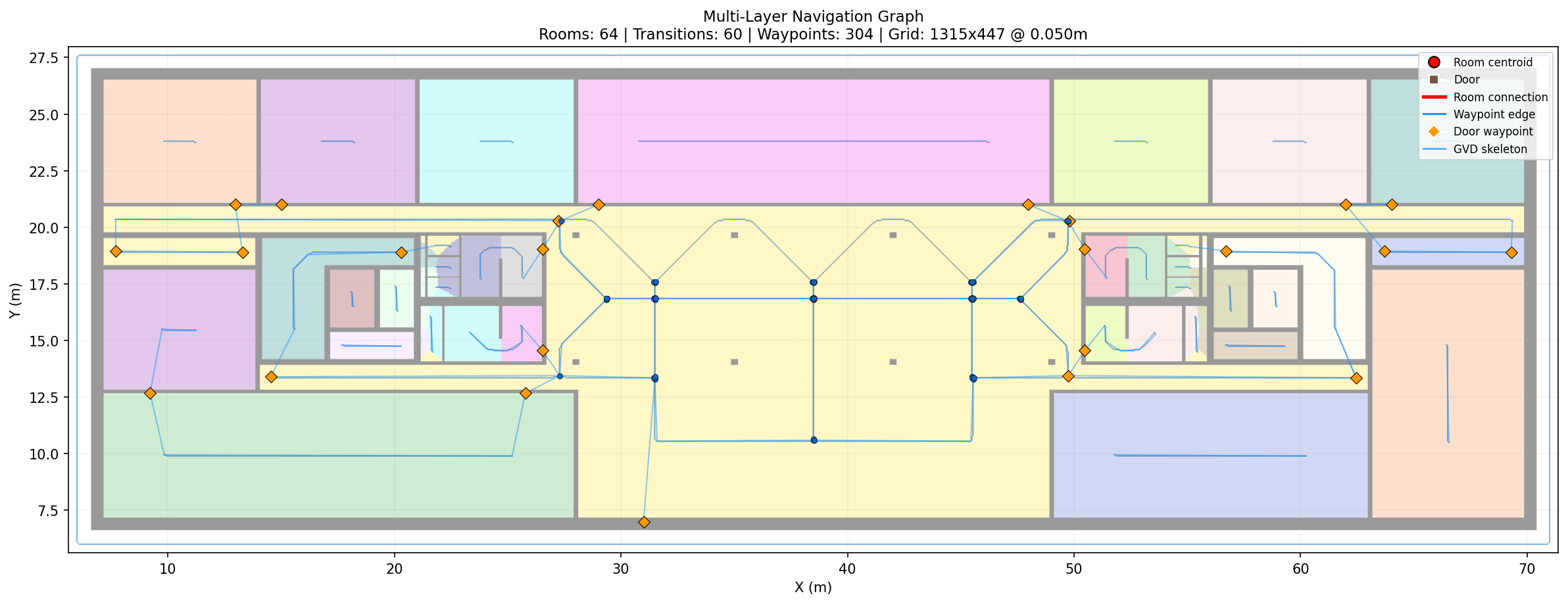
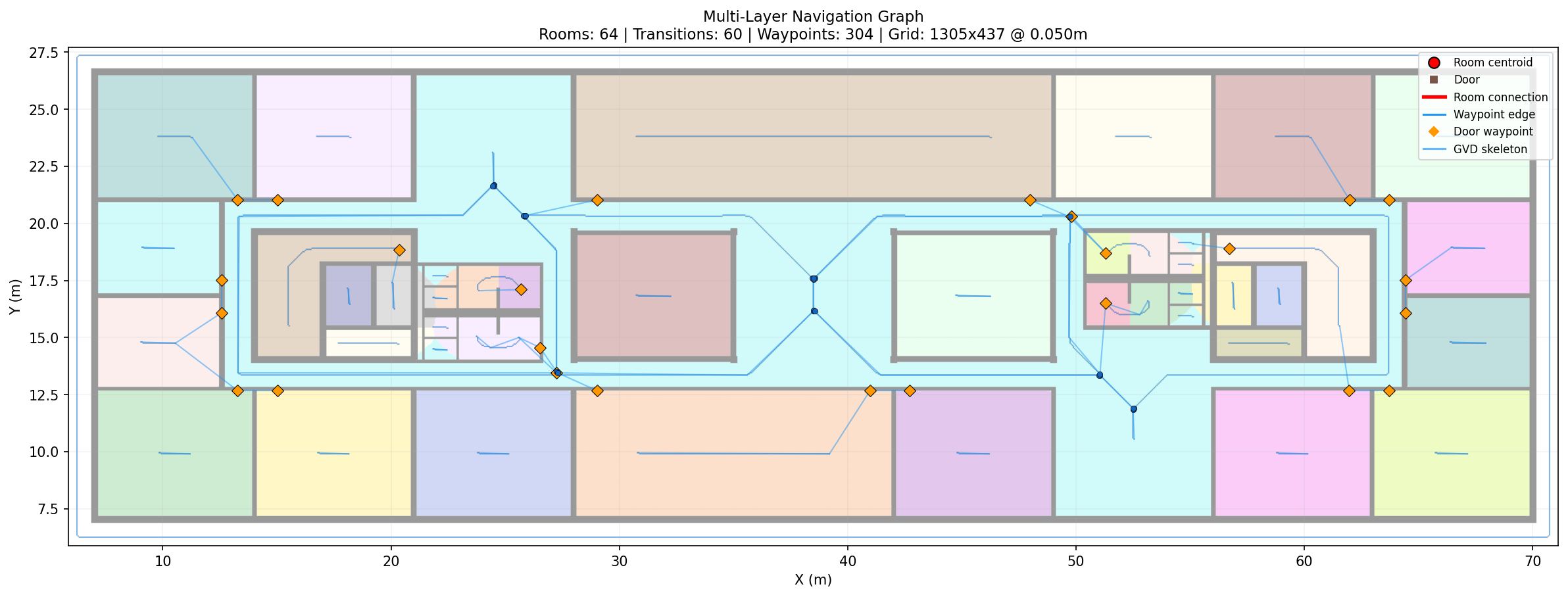
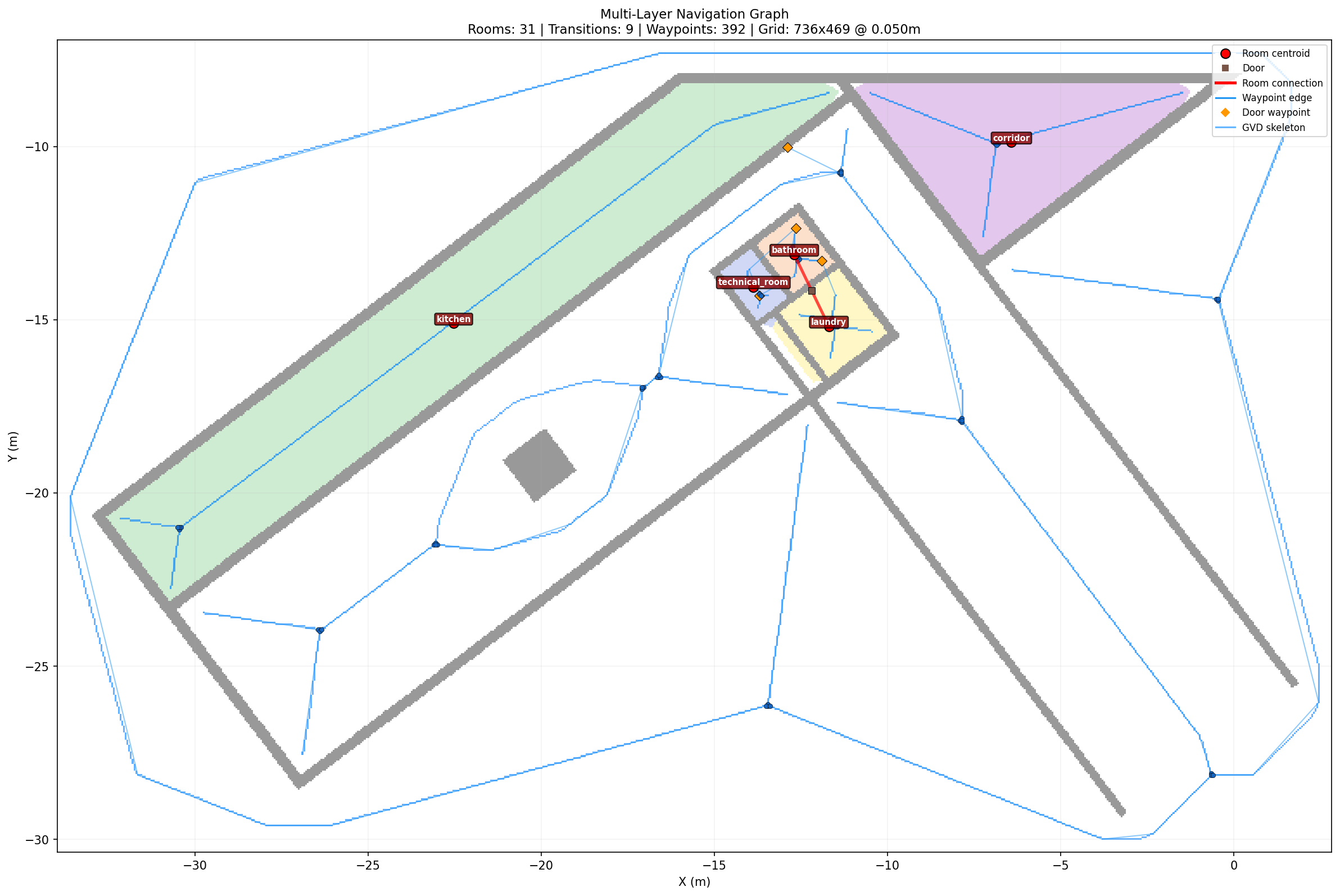
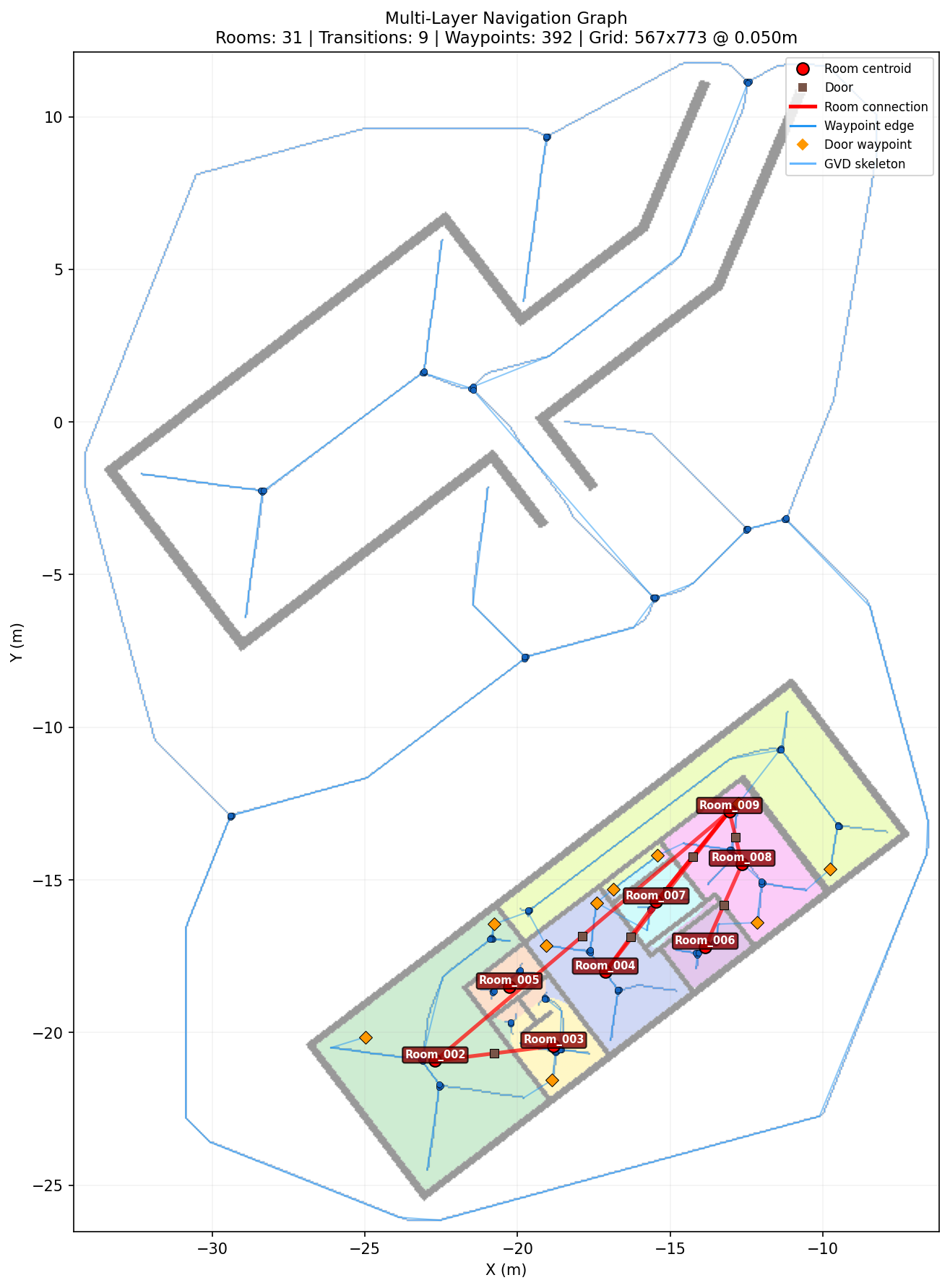
The enriched graph 𝒢agent has three linked layers. Each room is linked to its waypoint cluster, and each transition is linked to its crossing waypoint, supporting hierarchical planning.
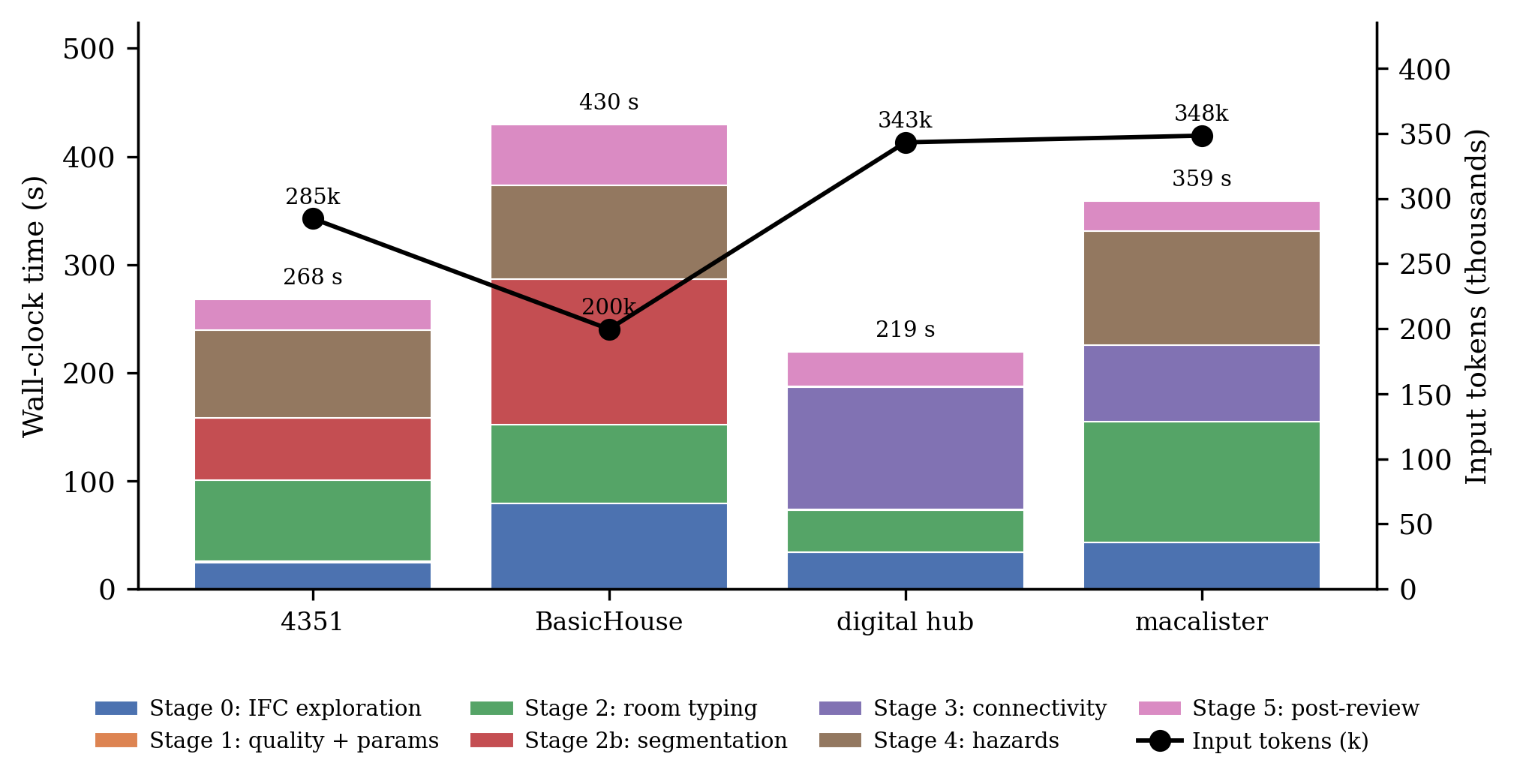
The agent wrapper adds seven stages. Each stage reads from and writes to a shared Pipeline Context. A topology regression gate audits every edit and rolls back any change that reduces the connected-transition count below the deterministic baseline.
We evaluate RoboBIM on four public IFC models from IFC Bench:
4351,
BasicHouse,
digital_hub, and
samuel_macalister_sample_house.
These cover residential, mixed-use, and office layouts with 14–64 rooms across 2–6 storeys.
| Model | Storeys | Geometry (preserved) | Semantic Enrichment (static → agent) | Agent Cost | ||||||
|---|---|---|---|---|---|---|---|---|---|---|
| Rooms | Conn. | Waypoints | Type | w/ Hazard | Traversability | Material | Time (s) | Tokens in/out | ||
4351 | 5 | 22 | 90 | — | 1 → 3 | 0 → 22 | 0 → 5 | 0 → 5 | 294 | 285k/32k |
BasicHouse | 2 | 14 | 6 | 32 | 0 → 7 | 0 → 7 | 0 → 14 | 0 → 7 | 489 | 200k/24k |
digital_hub | 3 | 64 | 60 | 304 | 38 → 64 | 0 → 0 | 0 → 64 | 0 → 1 | 423 | 343k/32k |
macalister | 6 | 31 | 9 | 392 | 12 → 17 | 0 → 9 | 0 → 31 | 0 → 6 | 407 | 348k/41k |
| Total | 16 | 131 | 85 | 818 | 51 → 89 | 0 → 19 | 0 → 131 | 0 → 18 | 1612 | 1176k/129k |
Geometry columns are identical for both pipelines (gate forbids regression). Semantic enrichment columns: static → agent.
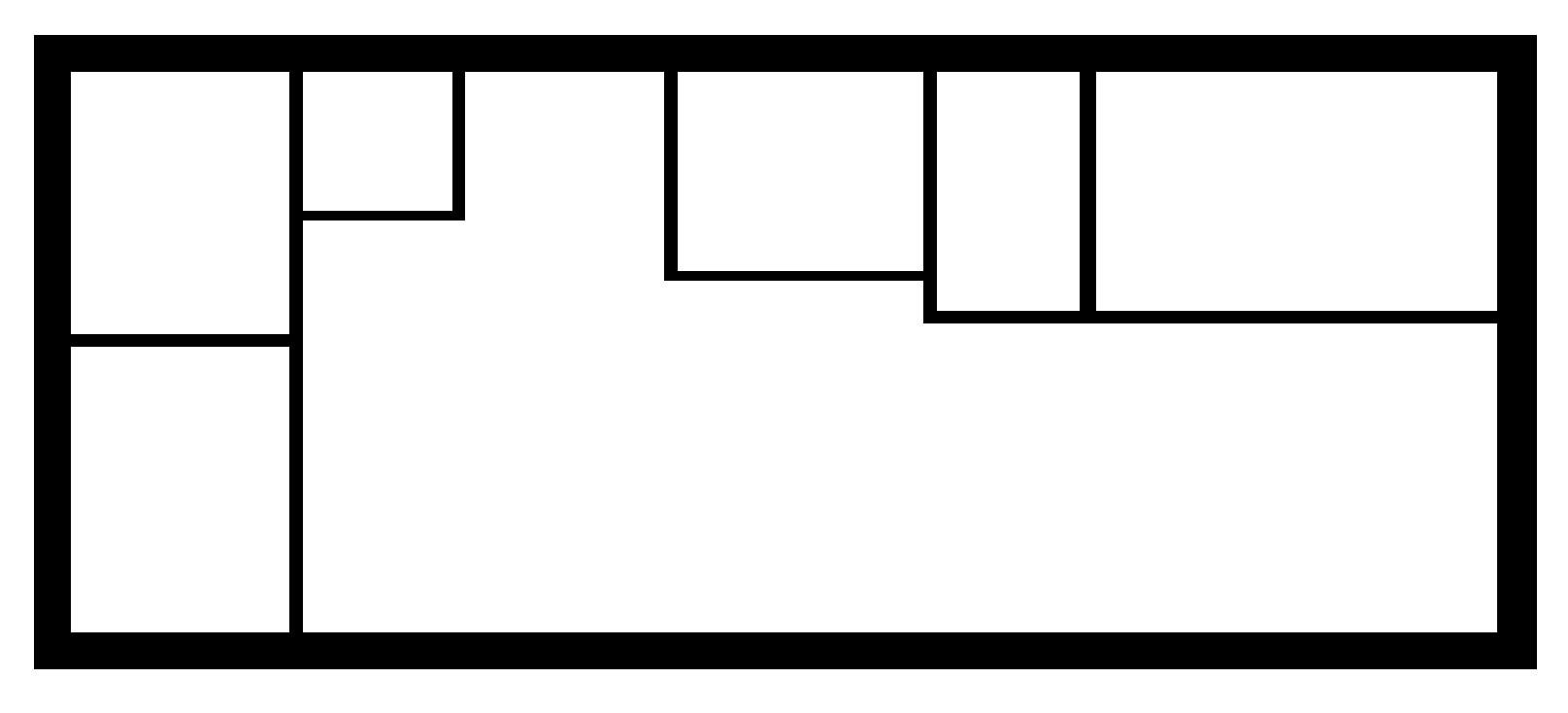
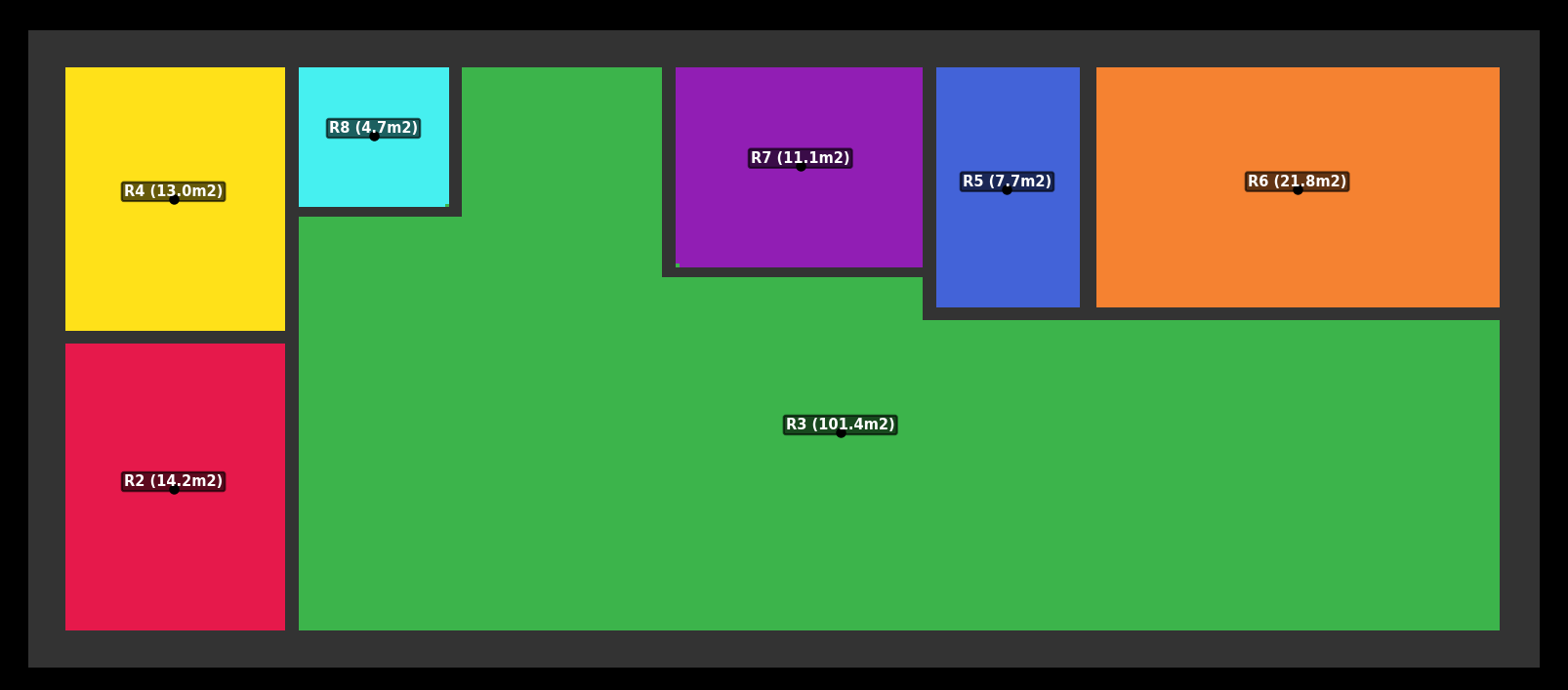
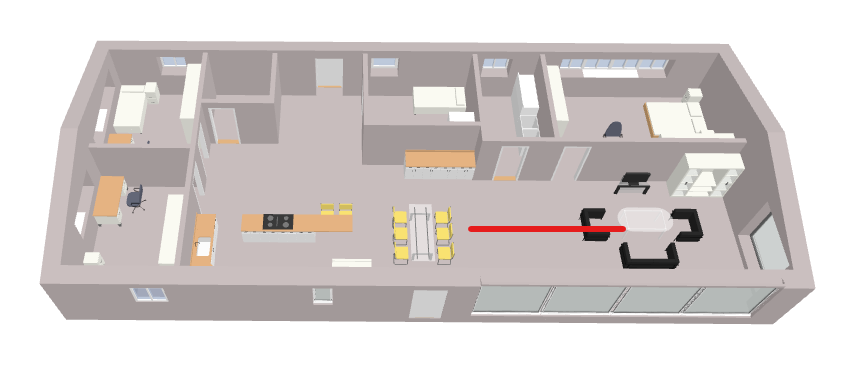
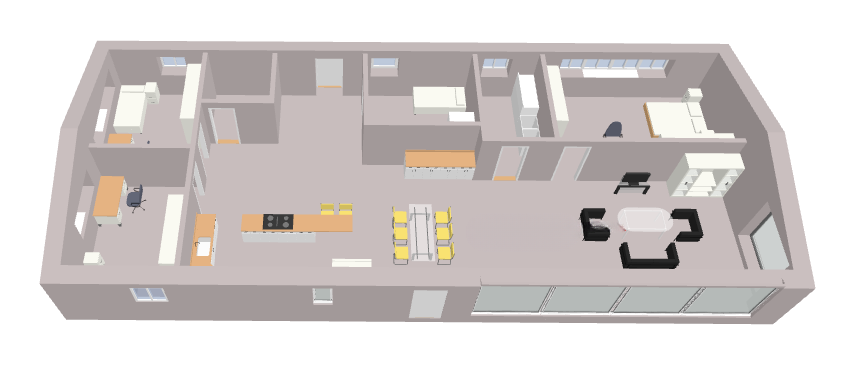
Visualizations of the three-layer navigation graph across evaluated IFC buildings. The agent enriches grey unlabelled rooms with inferred room types, hazard codes, and traversability scores.
If you use RoboBIM in your research, please cite our workshop paper:
@inproceedings{nedungadi2026robobim,
title = {{RoboBIM}: Scaling Robot Semantic Foundations
through Agentic Extraction of {BIM} Priors},
author = {Nedungadi, Ashwin and
Nithyanantham, Bharathi Kannan and
Luedtke, Stefan},
booktitle = {ICRA 2026 Workshop on Robots Meet Prior Maps:
Leveraging Geometric and Semantic Priors for
Real-World Robot Autonomy},
year = {2026},
note = {Equal contribution: Nedungadi, Nithyanantham}
}